I’ve spent more than 20 years working in construction, and I’ve seen good people lose money over mistakes that never should have happened.
Not because they could not do the work. Not because they did not care. Not because the project was impossible.
They lost money because the right information did not reach the right person at the right time.
Sometimes it was a drawing that had been revised, but the old print was still sitting in the gang box. Sometimes someone knew about a change but assumed everybody else did too. Sometimes the office uploaded a file, but the field never knew it was there. Other times the field discovered a problem, mentioned it during a phone call, and the details disappeared as soon as that call ended.
Construction companies often look for one big reason a job went bad. The truth is usually less dramatic. Profit leaks out through small gaps—one missed update, one unanswered question, one wrong quantity, one crew waiting on information. Those gaps do not look expensive when they first happen. They become expensive after people, material and equipment start moving in the wrong direction.
The $100 mistake nobody worries about
Picture a mechanic or installer working from an outdated drawing. The change is minor. A penetration moves. A dimension changes. A piece needs to be remade. Maybe the direct cost is only $100 in material and a couple hours of labor.
Most companies absorb that without much discussion. It becomes “one of those things.”
But the direct cost is rarely the whole cost. Someone has to stop. Someone has to confirm the change. A foreman may leave productive work to sort it out. The shop may have to remake material. A delivery may need to be scheduled. Another trade may be waiting. The daily plan changes, and the work that was supposed to happen gets pushed.
The $100 mistake may actually cost several times that amount by the time the project gets moving again. More importantly, it is a warning. If the system allowed one outdated drawing to stay in circulation, it can allow another.
Was this a one-time mistake—or did the company’s process make the mistake easy to repeat?
When the wrong drawing reaches a whole crew
Now take the same problem and scale it up. A ten-person crew works most of a day from the wrong information. Material is installed. Hangers are set. Equipment is moved into place. By the time the issue is discovered, the work is no longer a simple correction.
It has become demolition, replacement material, overtime, schedule recovery and conflict between companies trying to decide who owns the cost.
That is where communication mistakes stop looking like paperwork problems and start showing up in job cost.
The worst part is that everybody may have done exactly what they were told. The office may have received the revision. The project manager may have saved it. The foreman may have printed what was available. The crew may have installed it correctly according to the sheet in front of them.
Every person can do their job and the company can still lose money because the handoff failed.
Rework does not stay in one line item
Rework spreads. It consumes labor that was budgeted for new installation. It interrupts production. It forces supervisors to manage problems instead of planning work. It can hold up inspections, delay other trades and damage relationships with the general contractor or owner.
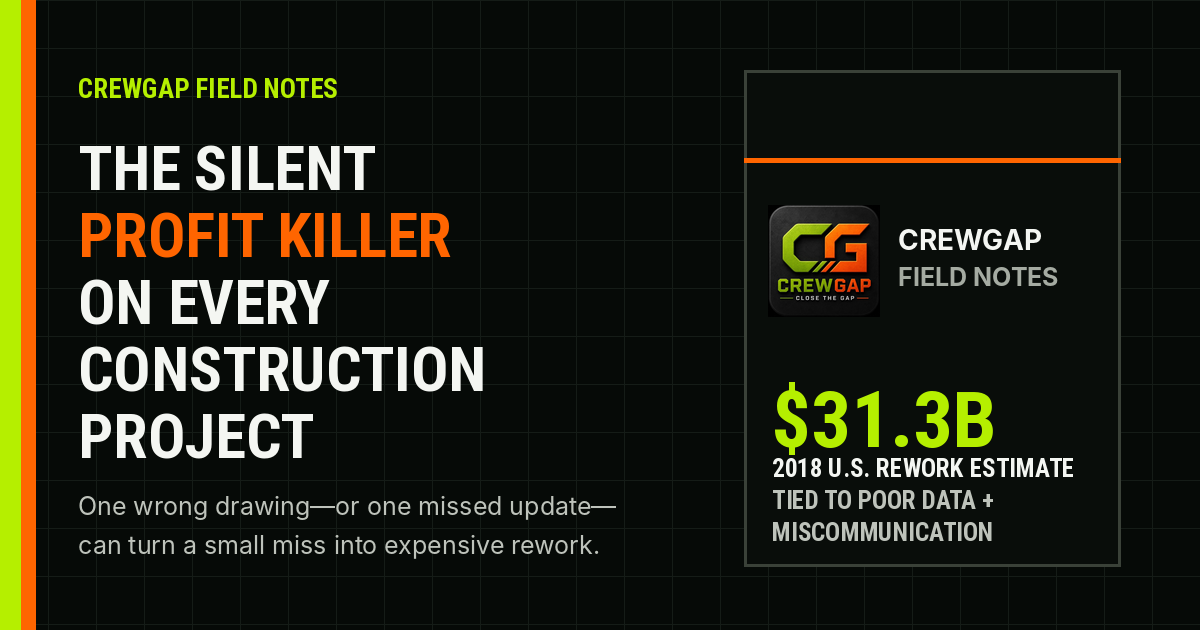
A 2018 study from PlanGrid and FMI estimated that poor project data and miscommunication were responsible for 48% of U.S. construction rework—about $31.3 billion that year. The same research separated the estimate into roughly $17 billion tied to poor communication and $14.3 billion tied to poor project data.
Those are industry-wide numbers, but the pattern is easy to recognize on an individual job. People spend hours searching for information, resolving conflicts and dealing with mistakes that could have been prevented by a clearer process.
The number does not have to be $31 billion to matter to your company. It may be the margin on one project. It may be the overtime you did not plan. It may be the customer you do not get back.
How a mistake reaches $1 million
A million-dollar communication mistake is usually not one person forgetting to send one email. It is a chain of small failures that builds over time.
A design change is issued. The updated document is stored in one place, but not communicated clearly. Procurement keeps moving with the previous information. Fabrication begins. Field layout starts. Equipment arrives. Work is installed. The conflict is discovered late, after several companies have committed labor and material.
At that point, the cost is not just the work that must be removed. It can include engineering, remobilization, expedited material, rental equipment, schedule extensions, liquidated damages, backcharges and legal disputes. On a large project, the impact can climb fast.
The original failure may have been as simple as this: the team did not have one dependable way to know which information was current.
More communication is not always better communication
Construction teams communicate all day. Phone calls. Text messages. Group chats. Emails. Meetings. Photos. Paper notes. Shared drives. Project platforms. The problem is not always a lack of conversation.
The problem is that the information is scattered.
A text message may solve the immediate question, but it does not automatically update the drawing the crew is using. A phone call may explain a delay, but it does not create a record the office can review later. An email may contain the correct attachment, but it does not guarantee the foreman knows the file replaced the version already printed.
Good communication is not measured by how many messages were sent. It is measured by whether the people doing the work can quickly answer four questions:
- What changed?
- Which information is current?
- Who needs to act?
- Was the change actually received and understood?
The foreman should not be the entire system
Construction often depends on experienced people remembering everything. The best foremen know the job, the crew, the schedule and the problems. They know who needs material, which employee is qualified, what changed yesterday and what the office is waiting to receive.
That experience is valuable. It should not be used as a substitute for a reliable system.
When information only exists in one person’s memory, the company becomes vulnerable. That person gets busy, takes a day off, changes projects or leaves the company—and suddenly nobody has the complete picture.
The best foremen are not the ones with the best memory. They are the ones who have enough visibility to lead the crew instead of chasing paperwork and reconstructing yesterday’s conversations.
What a better process looks like
A better process does not need to be complicated. In fact, complexity is often what causes teams to work around a system instead of using it.
The goal is to create one dependable path for project information:
- Make the current information obvious. People should not have to compare file names or search through messages to decide which drawing is correct.
- Connect changes to the work. A revision should be tied to the job, the affected people and the action required.
- Keep a record. Daily reports, issues, files and decisions should remain available after the phone call ends.
- Confirm the handoff. Uploading a document is not the same as making sure the field received it.
- Design around the people using it. A system that works for the office but slows down the field will eventually be ignored.
The technology matters, but the process matters more. A company can buy the most expensive platform available and still have the same problems if nobody knows where information belongs or who is responsible for keeping it current.
Why I built CrewGap
I did not build CrewGap from behind a desk. I built it from the field after watching the same gaps cause the same problems over and over.
The office needs to know what happened today. The field needs the latest information without digging through five different places. Employees need a clear way to record time and daily activity. Supervisors need visibility without spending the entire day making calls. Owners need to see problems before they become surprises.
CrewGap is being built to bring those pieces together in one practical system—jobs, crews, time, reports, equipment, files and the operational information that keeps work moving.
Software will not eliminate every mistake. Construction is too complex for that. But it can make the right information easier to find, the wrong information easier to spot and the handoff between the office and field much harder to miss.
Protect the handoff
The next expensive mistake on a project may not begin with bad workmanship. It may begin with a file that was never updated, a question that was never answered or a change that was never confirmed.
Those moments look small. That is why they are dangerous.
Do not wait until rework appears on the cost report to treat communication like a financial issue. Build a process that protects the handoff before people and material start moving.
Because one wrong print can cost $100. The right print never reaching the field can cost much more.
CLOSE THE GAP